2025 Edition: The Best Speechify Alternative - Lovevoice vs Speechify
Discover why Lovevoice AI is the best Speechify alternative for content creators. Compare reading-focused vs production-focused AI voice generators with practical workflow insights and real-world testing strategies.
 Alex
Alex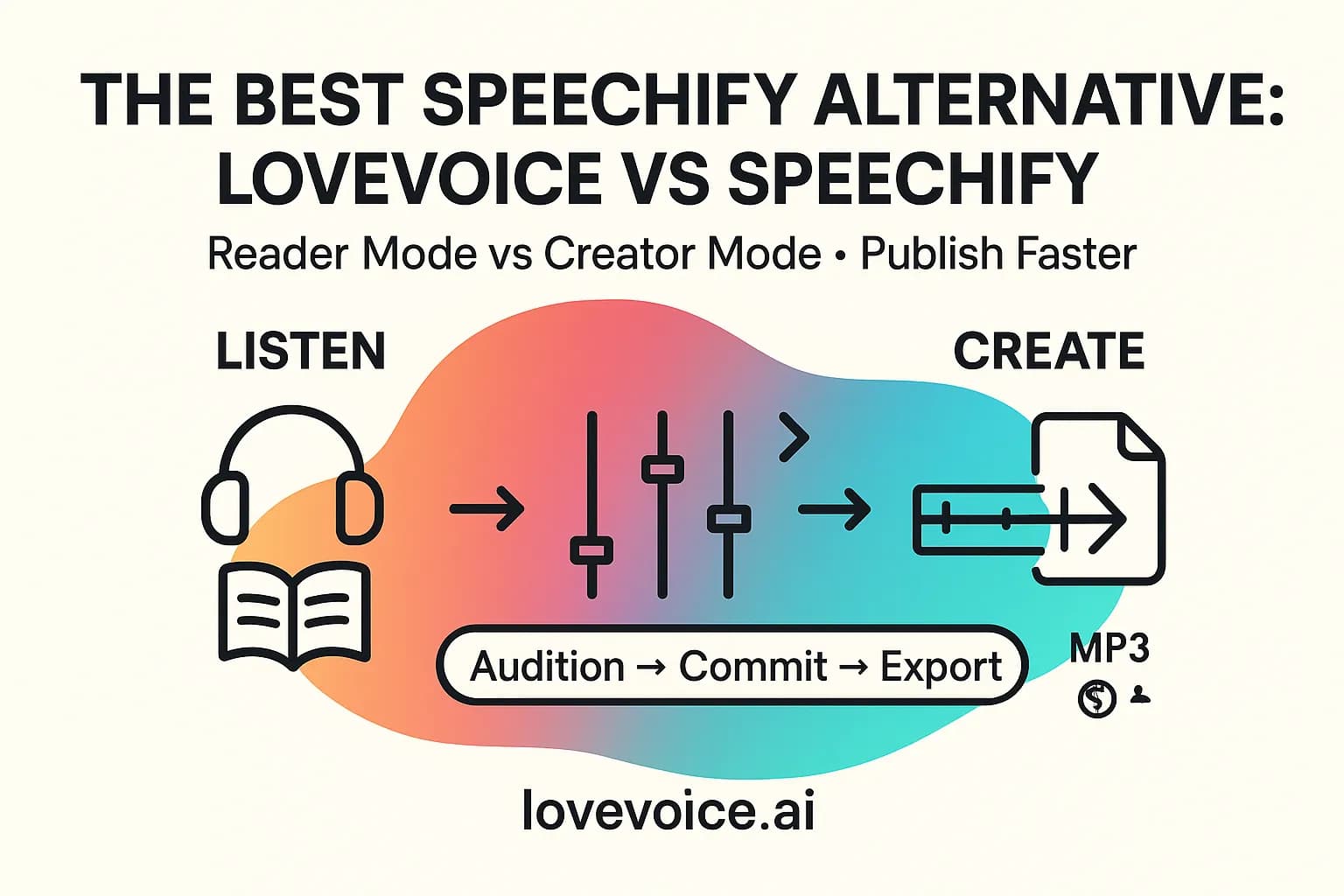
2025 Edition: The Best Speechify Alternative - Lovevoice vs Speechify
Choosing an AI voice generator today is less about raw specs and more about the kind of work you do. If your day revolves around listening—turning web pages, PDFs, and articles into audio you can skim on the go—then a reader-centric tool like Speechify feels natural. If your day revolves around producing—writing scripts, generating takes, exporting clean MP3s for videos, ads, explainers, or courses—then a creator-centric workflow matters far more. That's the lens through which this comparison makes sense, and it's why many teams looking for the best Speechify alternative inevitably evaluate the Lovevoice AI voice generator.
I. Overview & Key Takeaway
The story of Speechify is the story of speed reading with your ears. It's built to help you consume longform material: you load text, choose a voice, tweak playback, and move faster through information. For students, researchers, and busy professionals who live inside browsers and mobile apps, that focus is a genuine strength. You can jump between sections, keep your place, and treat audio like a smarter highlighter. As a reading experience, it's polished and familiar, and it rewards anyone whose main job is to absorb more content in less time.
Where creators start to hesitate is in the handoff from listening to publishing. Production work isn't just "make it talk." You rewrite a line, pause for breath, re-emphasize a word, export a draft take, spot a timing issue on the timeline, then render again—ten times if you must. You need an AI voice generator that keeps that loop tight and predictable. That is where the Lovevoice AI voice generator comes into its own: the interface wants you to finish a piece of audio, not just listen to one. It gets you from script to downloadable file with fewer detours, and it invites iteration—switch the voice, nudge rate or pitch, re-render, ship.
II. Quick Comparison: Speechify vs Lovevoice
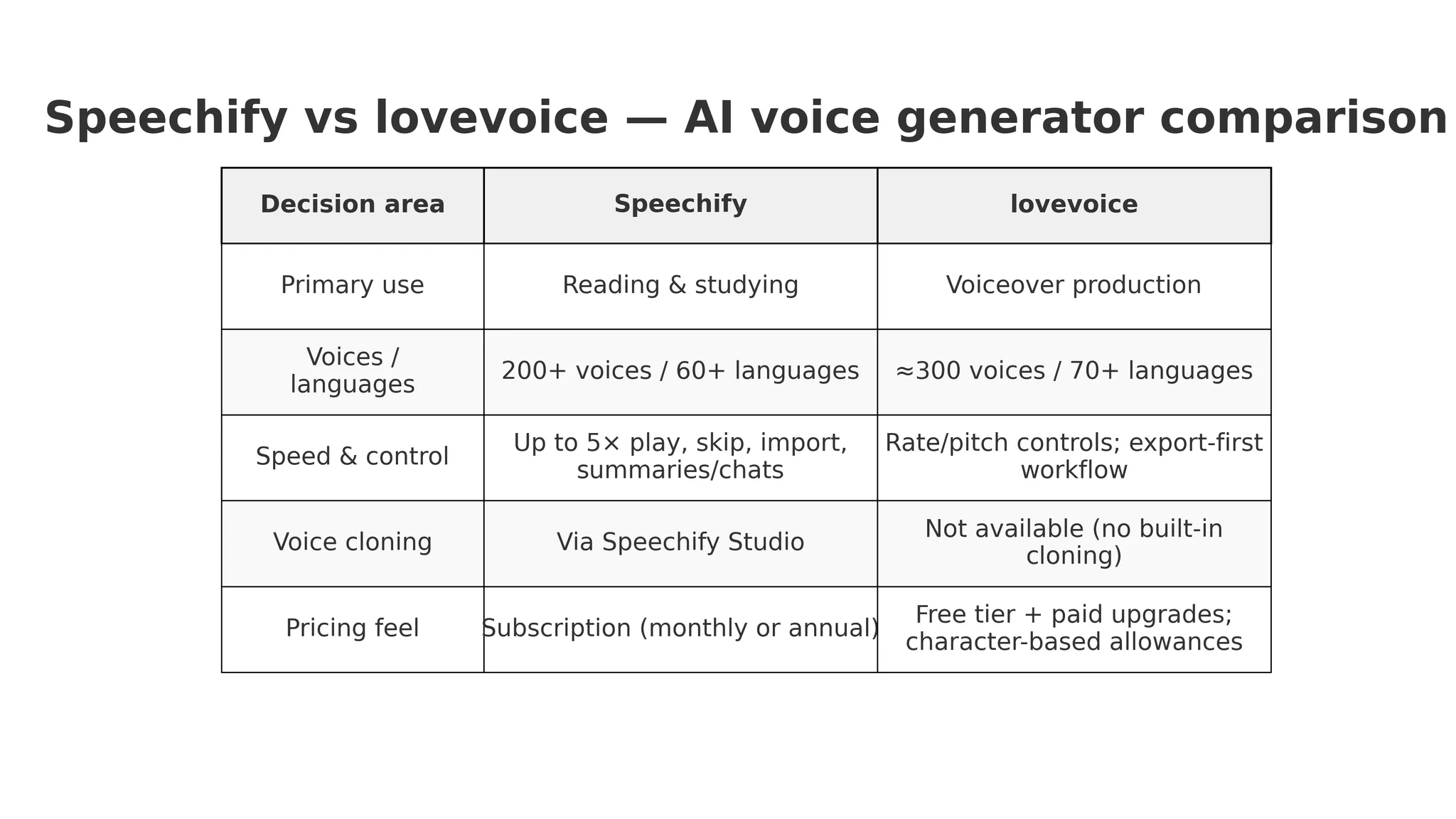
Quick overview of key differences between Speechify and Lovevoice AI across primary use cases, voice options, speed controls, voice cloning, and pricing models.
III. The Core Difference: Reading vs Production
Speechify: Built for Consumption
Speechify excels at the reading experience. It's designed to help you consume longform material efficiently:
- Speed reading with your ears: Load text, choose a voice, tweak playback, and move faster through information
- Smart navigation: Jump between sections, keep your place, treat audio like a smarter highlighter
- Mobile-first design: Polished and familiar interface for students, researchers, and busy professionals
- Content absorption focus: Rewards anyone whose main job is to absorb more content in less time
Lovevoice AI: Built for Creation
The Lovevoice AI voice generator is designed for production workflows:
- Creator-centric interface: Wants you to finish a piece of audio, not just listen to one
- Streamlined workflow: Gets you from script to downloadable file with fewer detours
- Iteration-friendly: Switch the voice, nudge rate or pitch, re-render, ship
- Production focus: Optimized for videos, ads, explainers, and courses
IV. Audio Quality & Voice Selection
Audio quality is the other pillar everyone asks about, and here the differences are more about personality than headline numbers. Both platforms deliver natural, modern voices; what matters in practice is whether you can quickly audition a handful of options, lock in a tone that fits your brand, and keep that tone consistent across languages or campaigns.
The Lovevoice AI voice generator encourages that "audition-commit-repeat" rhythm. You drop in a paragraph, preview a few candidates, choose one, then keep producing with minimal friction. For creators who publish weekly videos or run paid campaigns, shaving minutes off each render compounds into hours saved per month.
Key differences:
- Speechify: Optimized for listening comfort and speed
- Lovevoice AI: Optimized for brand consistency and production efficiency
V. Consistency & Workflow Reliability
Consistency is what turns a good demo into a reliable workflow. A creator doesn't want a great read once; they want the same delivery across a six-video playlist, or a 12-lesson course, or three product launches. That means the AI voice generator has to respect punctuation and pacing the same way, every time, and it has to make those controls obvious enough that you can correct course without digging through settings.
The Lovevoice AI voice generator leans into this repeatability: once you've found a voice and pacing that match your brand, you can stay in that lane and scale output without treating each new script as a fresh experiment.
VI. Speed: Reading vs Production
Speed matters, but not in an abstract way. Reading tools emphasize playback speed—2×, 3×, 5×—so you can finish more pages per hour. Production tools emphasize the speed of finishing: how long until you have a take you can send to the editor or upload to your CMS.
That includes render time, of course, but it also includes the little frictions that add up—how quickly you can duplicate a project, how easy it is to carry settings from one script to the next, how soon you notice a misplaced pause. The Lovevoice AI voice generator is tuned for that kind of speed. It helps you move from script to export without the ceremony of a reading app.
VII. Cost Structure Comparison
Cost structures tell a similar story. A reader's subscription makes perfect sense if you're listening every day, everywhere. A creator's workload often spikes—launch weeks, product updates, promotional pushes—and then calms down.
In that pattern, an AI voice generator that maps to production volume, lets you predict spend, and never gets in the way of exporting the final file is simply easier to live with. Teams that switch do it because the Lovevoice AI voice generator feels like a studio tool, not a reading app with export tacked on. Over a quarter or two, the difference between "always-on subscription" and "pay around your delivery schedule" becomes a real budget conversation.
VIII. Multilingual & Brand Consistency
Multilingual needs sit at the crossroads of these philosophies. Speechify's reader spirit helps you listen to material in many languages; the controls make it easy to jump around a long document and keep the gist. Production, however, asks a different question: can you build a consistent, brand-safe voice that holds up in more than one language and still sounds like you?
The Lovevoice AI voice generator approaches this with creators in mind: you audition a few options, discover which ones carry your brand tone across languages, and then you stick with them as you move from captions to full narrations. That familiar "find the voice, then scale the output" loop is what teams need when they're building a library of reusable assets.
IX. Collaboration & Team Workflows
There's also the practical matter of collaboration. In reading mode, the "team" is often just you and your backlog of articles. In production, the team might include a copywriter, a video editor, a project manager, and someone watching deadlines.
The Lovevoice AI voice generator slots into that chain because the deliverable is a file—an MP3 that can go straight into a timeline. Editors don't need to learn a new app or fiddle with a reader's UI; they just need the audio at the right level, with the right pacing, and they need it consistently. When you're producing on a schedule, that reliability is a relief.
X. Brand Safety & Compliance
Brand safety matters too. Reading tools are agnostic about what you're listening to; that's part of their appeal. But when you publish, you're not just hearing the text—you're endorsing it with your voice. An AI voice generator aimed at creators should make it natural to keep approvals, script sources, and usage intentions clear, so that the audio you release aligns with your brand's policies.
The Lovevoice AI voice generator keeps the focus on authorized scripts and predictable outputs, which helps teams align legal comfort with production speed. It's easier to brief stakeholders when the process looks like a studio rather than a novel reading app.
XI. Onboarding & Getting Started
Onboarding is another quiet differentiator. A reader app asks you to install extensions, grant access to web pages, and set up keyboard shortcuts so you can send articles to your queue. A production tool asks you to paste a script and pick a voice.
The Lovevoice AI voice generator rewards that second mindset. Within a few minutes you can move from a brainstorming doc to a first cut, listen on headphones, adjust the pacing you want for social cut-downs versus full explainers, and then export. That quick win shortens the distance between idea and asset, which is exactly what marketers and educators need.
XII. Real-World Testing Strategy
If you're coming from Speechify and testing alternatives, run a real-world trial rather than a checklist exercise. Pick a one-minute script that represents your normal work—an app walkthrough, a feature announcement, the intro of a tutorial—and produce it in both tools from start to finish.
Test checklist:
- Time the setup, the initial render, and the inevitable re-render after you notice a line that needs more emphasis
- Listen on your phone, then on your laptop speakers, because that's what your audience will do
- Compare the workflow from script to final export
- Evaluate consistency across multiple renders
You'll know very quickly where each tool shines. For most production-heavy teams, that test favors the Lovevoice AI voice generator because it keeps you focused on outcomes—clean takes, consistent tone, quick exports—rather than on the mechanics of reading.
XIII. The Bottom Line: Two Different Worlds
It's worth saying clearly: none of this is a critique of Speechify's original mission. It has helped a lot of people reclaim time and attention by turning text into listenable streams. But "AI voice" now serves two very different worlds. One world wants to consume content at speed; the other wants to create it at scale.
If you live in the second world, the Lovevoice AI voice generator is the practical, creator-first answer—and, for many, the best Speechify alternative not because it imitates a reader, but because it ignores that paradigm and optimizes for publishing. When you have deadlines to hit and deliverables to ship, that difference is not academic; it's the difference between hitting "export" at 4:00 p.m. and wrestling with tooling at 6:30.
XIV. Making the Right Choice
The final question is simple: what gets your work over the line? If the answer is "I need to listen faster," Speechify is a strong companion. If the answer is "I need to publish faster," the Lovevoice AI voice generator is designed for you.
Think about the next month—three explainer videos, a handful of social cut-downs, a landing-page demo, maybe a course lesson or two. Which flow sounds saner: opening a reader and bending it into a studio, or opening a studio-like AI voice generator that treats exporting as the finish line rather than an optional feature? The more your calendar looks like a release schedule, the clearer the choice tends to be.
Conclusion
In the end, the right tool shortens the distance between your script and your audience. For reading, that means fewer interruptions and smarter navigation. For production, that means smooth iteration, predictable rendering, and files that drop neatly into your editor.
On those production-first measures, creators tend to find their home in the Lovevoice AI voice generator. It doesn't try to be everything; it tries to be the fastest way from message to microphone, from page to publish. And if that's what your next project demands, it's very likely the best Speechify alternative for the work you actually do.
Ready to experience the difference between reading-focused and production-focused AI voice generation? Try Lovevoice AI for streamlined content creation workflows. Need guidance on selecting the right TTS solution for your specific use case? Contact our team for personalized recommendations.
บทความที่เกี่ยวข้อง
Best AI Voice Generator for YouTube in 2025: Complete Creator's Guide
Transform your YouTube content with professional AI voiceovers. Learn how to create consistent, clear narration with Lovevoice AI Voice Generator and leverage YouTube's multi-language audio for global reach.
The Right Way to Use AI Voice in Advertising: Complete 2025 Guide
Master AI voice advertising with Lovevoice AI Voice Generator. Learn proven strategies for creating consistent brand voices across short-form video, audio ads, and e-commerce content that drive conversions and reduce production costs.
2025 Edition: Best TTS Online Alternatives to ElevenLabs
Discover reliable, cost-effective text-to-speech services in 2025. Compare Lovevoice AI, PlayHT, Amazon Polly, Azure, and Google Cloud TTS with practical deployment tips and cost estimation strategies.